



In nearly every sport that involves reacting to an opponent, the ready position is one of the first fundamentals taught. Tennis players use a split step and a balanced stance before every return. Volleyball players lower their hips and keep their hands ready when receiving a serve. Basketball defenders stay in an athletic stance with active feet and hands up to protect the lane. Baseball infielders set their feet and prepare their glove before the pitch. These sports emphasize the ready position because it prepares the body and the brain to react efficiently, safely, and consistently.
Pickleball follows the same principle. While beginners often focus on learning how to hit the ball, the way a player prepares between shots has just as much impact on success. The ready position is the foundation that allows all other skills to work. Without it, movement becomes slower, reactions are delayed, and learning new shots becomes harde
For beginners, learning and practicing the ready position early can dramatically accelerate improvement and confidence on the court. It helps you protect yourself, it helps you switch into attacking mode faster, and it simplifies learning because many different shots can start from the same posture.
What the Ready Position Means in Pickleball
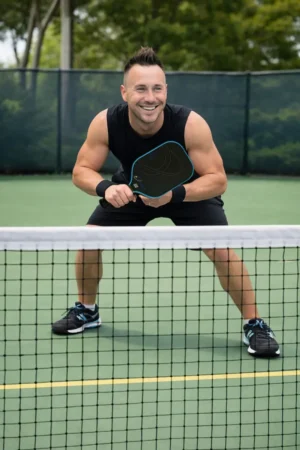
The ready position in pickleball is an athletic stance you use while waiting for the opponent’s shot. The knees are slightly bent, the feet are about shoulder width apart, and the weight is balanced on the balls of the feet. Your shoulders stay relaxed, and your paddle is held out in front of your body around chest height, not tucked against your stomach and not dangling near your knees.
This position keeps you balanced and alert. It allows quick movement forward, backward, or sideways without needing to reset your feet first. Instead of reacting late and reaching, you start prepared, then you step into the ball.
For beginners, the ready position removes hesitation. It gives you a reliable starting point, which is especially helpful when rallies speed up and the ball comes at you from different angles.
Reason One. Protecting Yourself and Controlling Direct Shots
One of the most practical reasons to use the ready position is protection. In pickleball, especially at the non volley zone line, the ball can be hit quickly and directly at your body. Beginners who are not prepared often turn away, freeze, or swing late. That reaction can lead to missed shots, pops ups that get punished, or uncomfortable contact.
The ready position helps protect you because the paddle is already in front of your torso. When a ball is driven at you, you can block it with a short, simple motion. If the ball is too fast to swing at, you can reset it softly back into the kitchen. If it comes slightly off center, you can still deflect it safely back into play.
This is not only about safety. It is also about control. When your paddle starts in front, your block becomes compact and stable. You are less likely to take a big backswing, and you are less likely to flick your wrist in panic. Over time, this readiness teaches you to stay calm during fast exchanges, which keeps you in rallies longer.
Reason Two. Switching to Attacking Mode Faster
Pickleball rewards players who can recognize attacking opportunities and act quickly. Many points are decided by a short window: a ball that sits up a little higher, a dink that floats, or a return that lands short. If you are standing tall, if your paddle is low, or if your weight is on your heels, you lose time getting set. That delay often turns an attacking chance into a defensive scramble.
The ready position shortens the transition from defense to offense. From a balanced stance, you can step forward and attack without extra preparation. Your paddle is already in the correct area, so you can take the ball in front of your body with better timing. Your legs and core can drive the motion, rather than your arm doing all the work.
For beginners, this is a major breakthrough. When you start ready after every shot, you begin to feel the rhythm of the rally. You are not guessing what to do next. You are prepared for either option, defend or attack, and that preparation makes your decisions quicker and cleaner.
Reason Three. Simplifying Learning and Making Progress Faster
Beginners often feel overwhelmed because pickleball seems to have many different shots: serve, return, third shot drop, volley, block, reset, dink, and overhead. If each shot starts from a different posture, learning becomes slow and confusing. You may also build inconsistent habits, which leads to inconsistent results.
The ready position simplifies learning because it creates one familiar starting point for many skills. When your brain recognizes the same posture between shots, it can focus on the main variable that changes, such as paddle angle or contact point. This makes learning quicker because your body is not reinventing your stance every time.
Starting from the same ready position also makes your practice more efficient. You can repeat a drill and know that your posture is consistent. That consistency helps you understand what caused a good shot or a mistake, and it speeds up improvement.
Common Mistakes Beginners Make Without the Ready Position
Beginners who do not use a ready position often stand too upright between shots. This raises the center of gravity and makes it harder to move quickly. Many also rest their weight on their heels, which slows the first step and makes forward movement feel heavy.
Another common mistake is holding the paddle low or letting it drift away from the body. When the paddle starts low, fast balls to the chest become difficult to handle. When the paddle starts behind the body, players tend to swing late or reach awkwardly, which reduces control.
The simplest correction is to build a habit: hit your shot, recover, and return to the ready position. This habit is the difference between reacting and preparing, and preparation is what leads to consistency.
Beginner Drills to Build a Reliable Ready Position
The drills below are designed for beginners. They build a consistent ready position, improve your ability to block and reset, and teach you how to transition into attack when the ball invites it. Practice them at a comfortable pace first. Speed can come later.
Drill One. Ready Position Reset Rhythm
Purpose: Build the habit of returning to the ready position after every shot.
How to do it: Stand at the baseline or near the non volley zone line with a partner or coach. Your partner feeds balls at an easy pace to your forehand and backhand. After you hit each ball, immediately return to your ready position. Check three things before the next feed: knees bent, weight forward, paddle in front.
Coaching tips: Keep the motion simple. The goal is not power. The goal is rhythm: hit, recover, ready. If you find yourself standing up after the shot, pause and reset. If your paddle drops, bring it back to chest height. Do sets of 10 to 20 balls, then rest briefly and repeat.
Drill Two. Body Protection Block and Soft Reset
Purpose: Learn to protect yourself from direct shots while controlling the ball back into play.
How to do it: Stand at the non volley zone line in your ready position. Your partner stands across from you and hits gentle to moderate pace balls toward your torso and shoulders, not at your head. Your job is to block the ball with a compact motion. Aim to keep the ball low and land it in the kitchen or just past the line with a soft reset.
Coaching tips: Do not take a backswing. Think of the block as a firm paddle face with a small push from the shoulder and a stable wrist. If the ball pops up, soften your grip and reduce forward push. If the ball goes into the net, open the paddle face slightly. This drill teaches calm under pressure, which is a major step for beginners.
Drill Three. Defense to Offense Transition
Purpose: Train the ability to switch to attacking mode quickly when the ball sits up.
How to do it: Start at the baseline in your ready position. Your partner feeds you a deep ball first. You return it with control and immediately reset into your ready position. Next, your partner feeds a shorter ball that is slightly higher. Step in and attack with a controlled drive or firm volley, depending on where you are positioned. After the attack, recover and return to ready again.
Coaching tips: The ready position is the trigger. If you stay ready, your first step forward becomes natural and quick. Do not rush the swing. Step first, then contact the ball out in front. Aim for a safe target, such as cross court, rather than trying to hit a winner. As you improve, your partner can vary the height and location to improve decision making.
Drill Four. Shadow Ready Position at Home
Purpose: Build muscle memory without a ball, which makes your on court practice more effective.
How to do it: Stand in an open space with your paddle. Move into your ready position. From there, simulate a forehand volley, then return to ready. Next, simulate a backhand volley, then return to ready. Add a small split step before each simulated shot to imitate game timing. Repeat for 2 to 3 minutes, rest, then repeat.
Coaching tips: Use a mirror if possible. Watch for the most common issues: standing up, locking the knees, and letting the paddle drift low. Keep your movements smooth and controlled. The goal is to make the ready position feel automatic, so you do it during games without thinking.
How to Know Your Ready Position Is Working
You will notice progress when you feel less rushed. Fast balls to the body will feel manageable because your paddle starts in front. Your feet will move sooner because your weight is forward. You will also notice that you can attack earlier because you are not wasting time resetting your posture.
Another sign of progress is that learning new shots becomes easier. When your stance is consistent, your practice becomes clearer. You can tell whether a mistake came from paddle angle, timing, or decision making, rather than from poor balance.
Final Thoughts
The ready position is one of the most valuable fundamentals a pickleball beginner can learn. It protects you from direct shots by making blocks and resets simpler and safer. It helps you switch into attacking mode faster when the ball gives you an opportunity. It also simplifies learning because many different shots can start from the same ready posture.
If you want faster progress, do not treat the ready position as a minor detail. Treat it as the base that supports everything else. Practice the drills, build the habit of resetting after every shot, and commit to staying ready. When that habit becomes automatic, your game will improve quickly and your confidence will rise with it.
Picture Source: AI-generated
