



The #3 most-asked question on Reddit’s pickleball community — 6 proven fixes for dinks, drops, volleys, and everything in between.
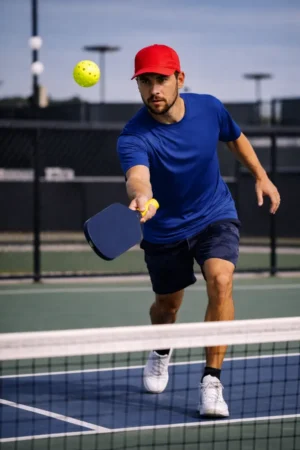
You hit a nice soft dink toward the kitchen. Instead of staying low and drifting gently over the net, the ball sails up like a slow balloon straight to your opponent’s paddle. They smash it. Point over. You scratch your head. Sound familiar?
If you have ever asked yourself, “Why do I keep popping the ball up in pickleball?” you are in great company. This is the third most-asked question on Reddit’s r/Pickleball community every single year, with nearly 760 posts about it. It does not matter if you have been playing for two weeks or two years. Almost every player faces this problem at some point.
The good news? Pop-ups do not happen by accident. They happen for very clear, fixable reasons. Once you know what is causing yours, you can fix it fast. This guide walks you through the six most common causes, explained in plain English, plus a simple drill that fixes the problem almost immediately.
What Exactly Is a Pop-Up?
A pop-up is when you hit the ball, and it floats too high above the net. Think of a balloon going up instead of a frisbee skimming flat and low. When the ball pops up, your opponent gets a free overhead smash. It is like accidentally lobbing someone a pizza and handing them a fork at the same time.
The goal in pickleball — especially near the kitchen (the no-volley zone closest to the net) — is to keep your shots LOW. Low balls force your opponent to reach down and hit up, which strips away their power and control. High balls do the complete opposite: they hand your opponents exactly what they want.
Here is the simplest way to think about it: every pop-up you hit is basically a free gift to the other team. Your job is to stop giving out free gifts.
6 Real Reasons You Keep Popping the Ball Up
Coaches, pro players, and the Reddit pickleball community all agree that pop-ups almost always come from one of these six mistakes. Read through like a checklist and figure out which one is showing up in your game.
1. You Are Squeezing the Paddle Too Hard
This is the number-one cause most beginners never even think about. When you grip your paddle tightly like you are squeezing water out of a sponge, you turn your paddle face into a hard brick wall. When the ball hits a brick wall, it bounces off hard, fast, and with zero control. That is a pop-up.
Think of catching an egg. If you grab it hard, it flies away and breaks. If you hold your hands gently and let them settle in, you can control them perfectly. That same “soft hands” idea is the foundation of great pickleball.
The fix: on a scale from 1 to 10, where 10 is white-knuckled and 1 is barely holding it, aim for a 3 or 4.
2. Your Backswing Is Too Big
Pickleball dinks are tiny, gentle, controlled shots, but many players treat them like a full tennis forehand and wind up with a huge backswing. That wind-up creates extra momentum, and extra momentum sends the ball flying too far and too high.
Coaches at SportsEdTV teach a simple test: if your paddle swings back past your own peripheral vision — meaning you can no longer see it in the corner of your eye, your backswing is too big. Keep the paddle in front of your body the whole time.
Easy mental image: you are gently brushing dust off a coffee table. Short, soft, quiet motion. Not a baseball swing. Small backswing, small follow-through, big control.
3. Your Feet Are Still Moving When You Hit the Ball
This one surprises many players. Pop-ups often come not from your arms, but from your feet. When you are still moving while you swing, all that body movement adds hidden energy to the ball and sends it sailing high.
The Dink Pickleball, one of the most widely-read pickleball publications in the world with over one million readers, explains it this way: the best players are completely still, like a freeze-frame photograph, right before contact. They hustle to get into position, stop, then hit.
The rule to practice: by the time you see the ball cross the net, your feet should already be planted and your paddle already set. Choose forehand or backhand before the ball gets to you. Plant your feet. Then swing.
4. Your Paddle Face Is Tilted Too Far Open
Picture your paddle like a small ramp. If the face points straight at the net like a flat wall, the ball goes into the net. If the face tilts slightly open toward the sky, the ball arcs nicely over. But if it tilts too far open — like you are scooping ice cream out of a container — the ball goes straight up. That is a classic pop-up.
Pro player Catherine Parenteau, one of the top-ranked doubles players in the world, has an entire tutorial about this. She says: a slight open angle is perfect. Too open and you lose all control. You want just enough tilt to send the ball over with a gentle arc — nothing more.
Bonus tip from Better Pickleball: if your weight is sitting back on your heels, your paddle face naturally falls open toward the sky all on its own. Shift your weight forward onto the balls of your feet, and your paddle angle improves automatically without even thinking about it.
5. You Are Rushing the Ball Off the Short Hop
A “short hop” is when you panic and hit the ball the instant it bounces off the ground, while it still has a ton of energy and speed in it. It is like trying to catch a basketball right at the bottom of its bounce, too much force happening all at once.
That leftover bounce energy transfers straight through your paddle and launches the ball high. PlayPickleball.com coaches call the short hop a “last resort” move; only do it when you have absolutely no other choice.
The better habit: be patient. Let the ball bounce, rise off the ground, reach its peak height (called the apex), and drop just slightly before you swing. That extra half-second of patience gives you a much quieter, more manageable ball to work with.
6. You Are Lifting Your Head Before You Hit the Ball
This lesson is over 100 years old; it comes straight from golf and baseball. When you lift your head to peek at where the ball is going before you actually make contact, your paddle lifts with your head. That tiny upward flick moves your contact point from the sweet spot in the middle of the paddle to the edge, and that turns a perfect dink into a pop-up every time.
The Dink Pickleball puts it perfectly: keep your chin down and close to your chest all the way through the moment of contact. Stay down on the ball. Here is the surprising part: you can actually feel when you have hit a great shot without looking up. Trust the shot first. Then look.
The One Drill That Fixes Almost Everything
If you only have time for one drill to stop your pop-ups, make it this one. It is used by coaches nationwide and comes directly from pro players at the highest level. Catherine Parenteau, one of the best doubles players in the sport, calls it the “Catch and Release” drill.
Here is exactly how to do it:
- Set your paddle down completely on the ground.
- Have a friend toss a ball gently toward you.
- Catch the ball with your bare hands using soft, relaxed hands, then FREEZE. Do not let your hands move forward after the catch. Just hold the ball completely still.
- Pick up your paddle and repeat, but treat the paddle like your hand. When the ball contacts the paddle face, FREEZE. No follow-through. Just absorb it and hold.
- Do this for five minutes before every practice session or game.
This drill directly rewires your muscle memory to absorb the ball’s energy instead of punching it back. It retrains the most common mistake, following through too much on defensive shots, and it works at every level, from complete beginner to advanced competitor.
Your Quick Pop-Up Checklist
Run through this list in your head before every dink or defensive shot:
- Am I gripping the paddle softly? (aim for 3 out of 10 pressure)
- Is my backswing small? (Can I still see my paddle in the corner of my eye?)
- Are my feet planted before I swing? (freeze-frame right before contact)
- Is my paddle face just slightly tilted — not scooping up toward the sky?
- Did I wait for the ball to come to me instead of rushing it?
- Am I keeping my chin down through contact?
Frequently Asked Questions
Q: How tight should I hold my pickleball paddle?
A: About a 3 out of 10 on a tightness scale, loose enough to have feel and sensitivity, but firm enough that the paddle will not fly out of your hand. A tight grip creates too much uncontrolled power, which is the main recipe for a pop-up.
Q: Why do my dinks still pop up even when I try to hit softly?
A: Even when you intend to hit softly, a big backswing, moving feet at the moment of contact, or rushing the ball off the short hop can still add hidden energy to the shot. Check your footwork first. Are your feet truly still when you hit? That is usually the surprise culprit.
Q: Is popping the ball up just a beginner mistake, or do advanced players do it too?
A: Both. Coaches at SportsEdTV say it is one of the most common questions from intermediate and even advanced players. The difference is that better players pop up less often and recover faster. It is a technique issue that can be fixed at any level, not a skill-level issue.
Q: What does “soft hands” mean in pickleball?
A: Soft hands means holding your paddle with a relaxed, loose grip and letting the paddle absorb the energy of the ball instead of fighting it. Think of gently cupping an egg instead of grabbing it. Soft hands give you control. Stiff hands give you pop-ups.
Q: Should I let the ball bounce before hitting near the kitchen?
A: Most of the time, yes. Letting the ball bounce, rise to its highest point (the apex), and begin to fall before you swing gives you the most control. Hitting it right off the short hop, the instant it bounces, keeps too much energy in the ball, and is one of the most common causes of pop-ups.
Q: How quickly will my pop-ups improve once I know what to fix?
A: Most players see real improvement within one or two practice sessions once they identify the specific cause. The Catch and Release drill, done for just five minutes before play, can create noticeable changes right away. The key is turning these fixes into habits through repetition, not just trying them once and moving on.
The Bottom Line
Popping the ball up is one of the most common and most fixable problems in all of pickleball. You are not doing it because you are a bad player. You are doing it because nobody walked you through exactly what to look for until now.
Start with soft hands and see what changes. If the pop-ups keep coming, work down the checklist: backswing size, footwork, paddle face angle, patience at the bounce, and chin position. Most players can dramatically cut their pop-ups within just a week of focused practice.
The game rewards patience and control over power every single time. Keep it low, stay calm, and watch how quickly your opponents start struggling to deal with your shots instead of the other way around.
See you on the court!
— Coach Igor
Ready to Fix Your Game Faster?
Reading about fixes is great — but having a coach watch you play in real time and pinpoint your exact issue is a complete game changer. Coach Igor has helped players at every level, from brand-new beginners to competitive 4.0+ players, eliminate pop-ups and play cleaner, smarter, more consistent pickleball.
Book your free 15-minute discovery call today.
Tampa Bay area coaching available in person | Online lessons offered nationwide
Picture Source: AI-generated
