



So you just found pickleball. Maybe a friend brought you to the court. Maybe you saw a video online and thought it looked fun. Maybe you keep hearing that popping sound at the park and got curious. Welcome. You are about to love this sport.
Now you have the question every new player asks in their first week. What pickleball paddle should I buy?
It sounds easy. It is not. Open any pickleball forum and you will find opinions, brand names, and prices from nineteen dollars to three hundred dollars. As a pickleball coach who has taught hundreds of beginners, I am going to walk you through the ten most common answers people give to this question. I will tell you what is right and wrong about each one. Then I will give you the honest answer I would give a student standing right in front of me today.
The Ten Most Common Answers and What They Get Right and Wrong
Answer 1: Buy a Midweight Paddle
This is the most common advice beginners hear and it is mostly good. Midweight paddles weigh between 7.5 and 8.4 ounces. They give you a balance of control and power that works well when your swing is still new. You are not fighting the paddle to move it fast at the net and you are not losing power because the head is too light.
The bonus is that midweight paddles give you room to grow. If you want more power later you can add a small strip of lead tape to the head. If you want more speed you can switch to a lighter model. Starting in the middle keeps your options open.
The downside is that weight is very personal. Some players with arm pain or shoulder problems do better with lighter paddles. Players who come from tennis often want something heavier because it feels more like what they already know. Buying based on a weight range alone without feeling the paddle in your hand is like buying shoes without trying them on. It is a fine starting point but not the whole answer.
Answer 2: Start With a Budget Paddle Under Fifty Dollars
This advice makes sense if you are not sure you will stick with the sport. Why spend big money on something you might put in the closet?
The problem is that cheap paddles are often made with materials that make it harder to learn. They have dead spots, rough grips, and surfaces that give you bad information about your shots. You might think your dinks are bad because of your technique when it is really the paddle giving you false feedback.
I have watched beginners switch from a thirty dollar paddle to a ninety dollar paddle and look like completely different players in two sessions. The better paddle did not make them smarter. It just stopped lying to them. Spending a little more up front helps you learn faster and feel less frustrated.
Answer 3: Try It or Borrow a Paddle First
This sounds smart. Do not buy until you know you love the sport. For your very first session or two this makes sense.
The problems start quickly though. When you borrow your friend’s paddle you are usually borrowing the one they love most. It is probably expensive, broken in to their hand, and sized to their grip. None of that applies to you. You will get a false feel for what paddles are like.
There is also the damage problem. Pickleball paddles chip and scratch more easily than they look. Returning a cracked two hundred dollar paddle to your friend is an uncomfortable situation. Borrow for one or two early sessions to try the sport. After that you need your own equipment to build real feel.
Answer 4: Go With a Graphite or Fiberglass Face
This is genuinely good advice. Both graphite and fiberglass are much better than wood and most budget materials. Knowing the difference helps you choose wisely.
Graphite faces are stiffer and lighter. They give you great touch and feedback at the kitchen line. The ball comes off with more control which is great for soft shots.
Fiberglass faces have a slight springiness that adds a little extra pop. They forgive off center hits better than graphite which is very important when your technique is still developing. For most beginners fiberglass is the smarter starting choice because that forgiveness helps while you are still learning where the sweet spot is.
Answer 5: Spend Between Eighty and One Hundred Twenty Dollars
This is the advice I believe in the most. At this price paddles are made with real materials and real engineering. You get a good polymer core that gives you genuine touch. You get a proper hitting surface. You get a grip that holds up through months of regular play.
You are paying for a paddle that actually responds to what your hand tells it to do. Every dink you hit and every drop shot you try gives you real feedback through the paddle. If the paddle is made cheaply that feedback is wrong and your feel for the game stops growing.
You are also not spending money on pro technology you cannot use yet. Carbon fiber faces and foam injection systems are real improvements but they help players who already have polished technique. Right now you need honest equipment that forgives your mistakes while you learn.
Answer 6: Avoid Wood Paddles
Do not buy a wood paddle. This is not a matter of opinion. It is simply the wrong tool for learning this sport.
Wood paddles are heavy and slow. They often weigh more than nine ounces which makes them hard to move quickly at the net. They are dead on contact meaning the ball does not spring off with any consistency. They give you almost no feedback through the handle about whether you hit the ball cleanly. They also cannot generate spin because they have no real surface texture.
Playing with wood teaches you bad habits. The extra weight makes you swing with your arm instead of your whole body. The dead feel makes you overswing to get power. Both of those patterns will hold your game back for a long time. There is no price low enough to make wood a smart choice for someone who wants to actually improve.
Answer 7: Check Your Grip Size First
Grip size matters more than most beginners know and it is one of the most overlooked parts of picking a paddle. A grip that is too small forces you to squeeze too hard. That creates arm tension and raises your risk of getting pickleball elbow which is a real and painful condition. A grip that is too large reduces wrist movement and makes the small face adjustments that are important during soft exchanges much harder to do.
Most adults use a grip between four inches and four and a half inches in circumference. A quick test is to hold the paddle like you are shaking hands with it and slide your other index finger into the space between your palm and your fingertips. No room means the grip is too small. More than one finger of space means it might be too large.
The good news is that grip size is easy to adjust. Adding overgrip tape costs just a few dollars and can increase the circumference by up to a quarter inch per wrap. Starting a little smaller and building up is always easier than trying to shrink a grip that is too big. Check grip size but do not let a slightly imperfect fit rule out an otherwise great pickleball paddle.
Answer 8: Buy a Set That Includes Balls
A set seems smart. You get two paddles and some balls in one box. If you and your partner both want to start playing at the same time the appeal is real. You solve everything in one purchase.
The truth is that paddle sets are almost always designed around cost rather than quality. The paddles inside are built to hit a low price point which means budget cores, thin grips, weak surface materials, and edge guards that chip quickly. The balls included are often low durability plastics that crack fast in cold weather or on rough outdoor courts.
You are paying for the convenience of a complete package but sacrificing the quality of the paddle itself. If you and your partner both plan to play seriously you are both better off buying standalone paddles in the eighty to one hundred twenty dollar range and picking up a separate three pack of quality outdoor balls. The total cost is similar but the difference in how the paddles feel and perform is very noticeable right away.
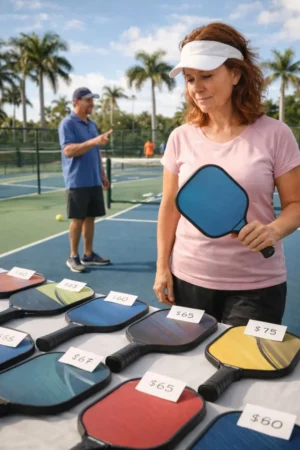
Answer 9: Go to a Shop and Demo Paddles
This is great advice and almost nobody actually does it because it takes effort. Most beginners just search online, watch a comparison video, and click buy. That process works reasonably well but it skips the most important step which is feeling the paddle in your actual hand during real play.
If there is a pickleball specialty shop or racquet sports store near you that offers a demo program, use it before you buy anything. A good demo program lets you take a paddle to the court for several days, hit with it in all kinds of situations including serves, dinks, drops, and volleys, and return it before you decide.
Within the first twenty minutes of hitting with a paddle you will learn things no review can tell you. Does the grip feel right or does it feel slippery? Does the ball go where you ask it to go or does it feel unpredictable? Is your arm relaxed after a session or is tension building? Those answers only come from hitting. A week of demo play is worth more than hours of reading reviews. The best shops will let you try several paddles in a row so you can compare them honestly.
Answer 10: Do Not Overspend Because You Will Upgrade Anyway
This is completely true. Most players who fall in love with pickleball will buy a second paddle within their first year. As your game develops your preferences get more specific. You start understanding whether you want more spin or more pop or a longer handle or a wider face. Paddles that work great for beginners often feel limiting once you reach a stronger skill level.
But this truth gets used as an excuse to start with bad equipment and that is where the thinking breaks down. Spending eighty to one hundred twenty dollars now and upgrading in twelve months to a one hundred fifty dollar paddle is a reasonable and cost effective path. Spending thirty dollars now and spending one hundred twenty later does not save you much money and it costs you months of honest skill development along the way.
Think of your first pickleball paddle as the foundation you build your game on. A good foundation does not have to be extravagant. It just has to be solid.
The Final Answer From Your Coach
Here is exactly what I would tell you if you walked up to me at the court and asked what pickleball paddle to buy.
Do not buy a heavy paddle to start. Lean toward the lighter side of the midweight range and know that you can always add lead tape to increase weight as your preferences develop. Weight customization is something advanced players do all the time and it costs almost nothing.
Set your budget at eighty to one hundred twenty dollars. That range gives you real technology and honest materials. Do not go lower thinking you are being responsible. You are just making it harder to learn.
Do not borrow paddles from friends beyond your first session or two. You risk damaging their equipment and you will pick up false information from a paddle that was made for someone else.
Do not look at wood paddles. That conversation is already over.
Check your grip size but remember that overgrip tape solves most grip size problems cheaply and quickly. Do not let grip size alone decide which paddle you choose.
Skip the sets. Buy a standalone pickleball paddle and buy balls separately. The quality difference in the paddle is real and you will feel it immediately.
Finally, if there is a shop near you with a demo program, start there. Spend a week hitting with two or three paddles in your price range. You will know quickly which pickleball paddle feels right. When you find that feeling, buy it and go play.
The court is waiting for you.
Frequently Asked Questions
How much should a beginner spend on a pickleball paddle?
A beginner should plan to spend between eighty and one hundred twenty dollars on their first pickleball paddle. This price range gives you access to real materials, a proper core, and a surface that gives honest feedback while you are learning. Going cheaper often means dealing with equipment that makes skill development slower and more frustrating than it needs to be.
Is it better to demo a pickleball paddle before buying?
Yes, demoing a pickleball paddle before buying is one of the smartest things a beginner can do. Many specialty shops offer demo programs that let you take paddles to the court for several days before committing to a purchase. Feeling how a paddle responds in real play tells you things that no review or video can show you.
Does grip size matter when choosing a pickleball paddle?
Grip size matters quite a bit because the wrong size can cause arm fatigue and injury over time. However grip size can be adjusted by adding inexpensive overgrip tape to build up a smaller grip. Start with a grip that feels slightly small and add tape as needed. This is easier than trying to shrink a grip that is too large.
Why should beginners avoid wood pickleball paddles?
Wood pickleball paddles are too heavy, too slow, and too dead on contact to help a beginner develop proper technique. They give almost no useful feedback through the handle and they cannot generate spin because they lack real surface texture. Playing on wood regularly builds habits that take a long time to unlearn once you switch to a proper pickleball paddle.
Picture Source: AI-generated
