




The backhand eastern grip is showing up on more courts every season. Players are learning that a stronger backhand can unlock cleaner dinks, heavier rolls, and more confident returns. If you are debating a change, this guide explains why the grip works, what you give up, when to make the switch, and a simple plan to adopt it quickly.
What Is The Backhand Eastern Grip
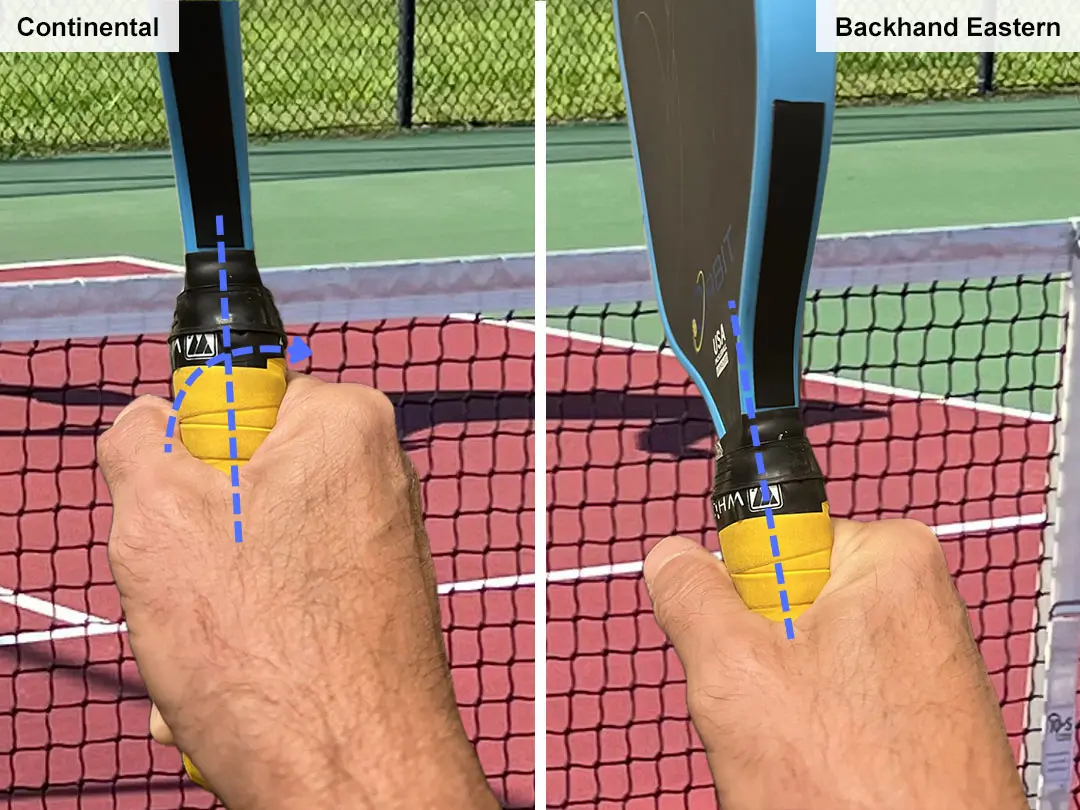
From a neutral handshake on the paddle, turn your hitting hand a little toward the backhand side until your index-finger knuckle and heel pad are on the backhand bevel. The front of the paddle closes a little on the forehand side and opens a little on the backhand side. Think of it as a backhand-first setup that you can still use on forehands with a compact swing.
Why Players Use It
• Backhand reliability. In the kitchen, the modern game makes you hit more balls with your backhand. A grip that favors the backhand makes it safer to block, dink, and reset when you’re under pressure.
• Topspin on the roll. You can brush up the back of the ball and roll through the middle or crosscourt lanes if you make contact a little in front and open the face a little more.
• Cleaner defense. It’s easier to handle the incoming pace when your wrist is stiffer on the backhand side. The paddle comes square, with no last-minute changes.
• Two-hand options. Adding a support hand to the eastern backhand orientation lets you hit drives, counters, and swinging volleys.
Advantages
• Stable paddle face on blocks and resets. Less wobble in the face means fewer pop-ups.
• Simpler mechanics at the kitchen. You can use one grip for all the different types of dinks, pushes, and rolls.
• Higher spin potential on backhand drives. The path encourages brushing up and through.
Better reach on the off hip. The blade lines up with the forearm for short counterpunches.
Disadvantages
• Forehand drive adjustment. To keep your forehands from sailing, you might need to shorten your backswing and turn your body more.
• Over-closed face on low forehands. Without a slight change in grip, touch forehands can hit the net.
• Learning curve on serves and overheads. Some players like these strokes to feel more neutral or continental.
• Transition period at the kitchen. Muscle memory from a forehand-first grip can help you fight the new angles for a few sessions.
When To Switch
Consider switching if three or more statements fit you.
• Your backhand dink or reset breaks down when the pace picks up.
• Your opponents aim for your backhand and win the hand battles.
• You depend on slice to get through backhand exchanges, and you have trouble adding a topspin roll.
• You’re getting ready to hit a two-handed backhand drive or counter.
• You already use a continental grip, but you want more spin and stability on your backhand shots.
The best time to make a full switch is during the two weeks of practice before a tournament or league cycle.
How To Train The Switch Fast
Day 1 to 3: Set the foundation
• Grip checkpoints. Use a washable marker to make a small dot on the backhand bevel. Make sure your index knuckle and heel pad line up on the dot between reps.
• Wall series, 10 minutes. Stand 12 feet away from a wall. Do 50 backhand blocks with a strong wrist, then 50 soft catches and pushes. Pay attention to your hands.
• Kitchen ladder. Crosscourt backhand dinks in groups of 15. Add a soft roll to every third ball.
Day 4 to 7: Add offense and defense
• Roll progression. Feed self tosses and rolls to small targets down the line, in the middle, and across the court. Maintain the contact point in front of your front hip.
• Reset ladder. Partner gives your body firm balls. Take in with as little backswing as possible and finish with the paddle tip touching the ceiling. Three sets of 12.
• Hands battle rounds. From the non-volley line, start with your backhand and play six ball exchanges. Practice short counters that hit your opponent’s feet.
Day 8 to 10: Blend forehand management
• Forehand tune-up. Hit forehand dinks, pushes, and rolls while keeping the backhand in an eastern grip steady. To control launch angle, add body rotation and a shorter takeback.
• Serve and third. If the serves float, try moving a little bit toward neutral for the serve only, and then go back to backhand eastern for the drop or drive on the third shot.
Day 11 to 14: Pressure and measure
• Goal games. First to five points, but a rally only counts if you made at least one backhand roll or counter with the new grip.
• Video check. Ensure that contact is made in front, maintain a quiet wrist, and achieve a level finish. Change the angle of your face, not the speed of your swing.
Common Mistakes And Quick Fixes
• Sailing forehands. Make the swing shorter and turn the body. To lower the launch, keep your wrist stiff.
• Netted backhand rolls. Lower your stance and touch farther away. Brush up, not across.
• Late grip drift. Set again between rallies. Use the dot until the position becomes second nature.
Bottom Line
The backhand eastern grip favors today’s fast exchanges and backhand-heavy patterns. You gain stability on blocks and resets and a clearer path to a topspin roll. You sacrifice a bit of forehand freedom, which you can solve with compact mechanics and smart rotation. Use the two-week plan above, track a few simple checkpoints, and you will switch with confidence and keep more points on your paddle.
Picture Source: I&G Pickleball
