



In today’s game, more coaches are emphasizing a simple but powerful principle: better footwork beats a stronger shot. While power can win quick points, balance, positioning, and timing consistently win matches. Proper movement improves shot quality, reduces unforced errors, and enhances recovery between shots. Understanding step through mechanics, split step timing, and momentum control will significantly improve performance at any level.
Step Through Mechanics: Transferring Power Efficiently
Step through mechanics allow players to generate controlled power through weight transfer rather than relying on the arm alone.
Proper sequence:
- Load on the back leg.
- Step forward toward the target.
- Transfer weight through contact.
- Finish balanced and ready for recovery.
When the lower body initiates the movement, the paddle follows naturally. This produces a heavier, more controlled shot. Players who swing mostly with the arm often lose balance and overhit.
Split Step Timing: Reaction and Court Coverage
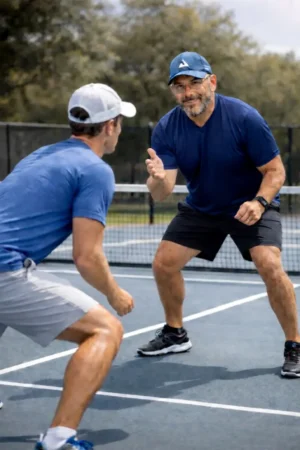
The split step is a small, controlled hop that prepares you to react in any direction. It should occur just before your opponent contacts the ball, allowing you to land balanced and ready to move.
Proper split step timing:
- Improves reaction speed.
- Enhances lateral movement.
- Prevents reaching and off balance contact.
Elite players use split steps on nearly every shot, even during fast kitchen exchanges. This constant readiness separates advanced players from recreational competitors
Momentum Control: Balance Equals Consistency
Momentum control prevents over-commitment. Many players hit a strong drive and fall forward, leaving themselves exposed to counters.
Proper momentum control involves:
- Staying centered over your hips.
- Decelerating before contact when necessary.
- Recovering quickly after the shot.
When transitioning from the baseline to the kitchen, controlling forward movement is critical. Rushing without balance often results in pop ups and defensive vulnerability.
Why Proper Footwork Is Critical on Key Shots
Return of Serve
The return of serve is one of the most important shots in pickleball because it sets up your ability to approach the kitchen line. Strong footwork on the return allows you to control depth, direction, and timing.
A proper return begins before the ball even crosses the net. As the server strikes the ball, perform a split step to load your legs and prepare for movement. From there:
- Move your feet first, not your paddle.
- Get your body behind the ball.
- Step through the shot with full weight transfer.
- Finish balanced and immediately move forward.
Many players focus only on hitting the ball deep, but depth comes from proper weight transfer and positioning. If your feet are late, you will often hit off your back foot, resulting in a short return. A short return gives your opponent an aggressive third shot opportunity.
Advanced players prioritize footwork on the return because it buys them time. A deep, well balanced return allows a controlled approach to the kitchen instead of a rushed sprint.
The Drive
The drive requires both stability and controlled aggression. While it is often viewed as a power shot, it is actually a balance dependent shot.
Before driving, establish a strong base:
- Widen your stance slightly.
- Bend your knees.
- Keep your weight centered.
As you initiate the swing, load on the back leg and step forward into contact. This creates forward momentum without losing balance. The key is not just hitting hard, but staying grounded through the shot.
Players who attempt to drive while leaning backward or falling forward lose consistency. Poor footwork causes mishits, balls into the net, or shots that sail long.
When executed properly, the drive becomes a controlled weapon. You remain balanced after contact, ready to defend a counterattack or transition forward.
Drops and Resets
Drops and resets require even greater foot discipline than drives. These soft shots demand touch, and touch is impossible without balance.
When preparing for a third shot drop or a reset in the transition zone:
- Lower your center of gravity.
- Move your feet to align your body behind the ball.
- Keep your weight slightly forward but controlled.
- Avoid reaching or leaning excessively.
Many players miss drops because they are still moving forward at full speed. Momentum must be managed. Decelerate before contact, stabilize your base, then execute the shot.
Resets during fast exchanges require micro adjustments. Small shuffle steps and subtle weight shifts allow you to absorb pace and keep the ball low. If your feet stop moving, your hands become late.
Soft shots are often misunderstood as paddle skill issues. In reality, most inconsistent drops and resets stem from improper positioning and balance.
How Professionals Train Footwork
High level players dedicate time to movement drills, including:
- Repetitive split step reaction drills.
- Baseline to kitchen transition drills with controlled stops.
- Lateral shuffle patterns that maintain an athletic stance.
- Shadow footwork without a ball to build muscle memory.
Their success is not just about paddle skill. It begins with efficient movement.
How You Can Train It
To improve your own footwork, incorporate:
- Shadow split step drills focusing on timing.
- Step through return drills emphasizing weight transfer.
- Transition control drills practicing deceleration.
- Lateral cone drills to strengthen balance and positioning.
Consistent repetition creates automatic movement patterns that hold up under pressure.
Power may look impressive, but movement wins matches. Step through mechanics, split step timing, and momentum control create stability and repeatable shot quality. Players who prioritize footwork develop consistency, confidence, and better decision making.
If you want to build a stronger foundation and elevate your performance, Coach Igor can assist you with structured footwork training tailored to your skill level and goals.
FAQs
1. Why is footwork more important than power in pickleball?
Proper footwork creates balance and positioning, which lead to more consistent and controlled shots than relying on arm strength alone.
2. What is a split step in pickleball?
A split step is a small hop performed just before your opponent hits the ball, allowing you to land balanced and react quickly.
3. How does step through mechanics improve my drive?
Stepping through transfers body weight into the shot, creating controlled power and better accuracy.
4. Why do I lose balance when I hit hard shots?
Most balance issues come from poor momentum control or improper weight distribution during contact.
5. How can I improve my transition to the kitchen line?
Practice controlled forward movement and deceleration drills to prevent rushing and losing balance.
6. How often should I train footwork?
Footwork should be incorporated into every practice session, even for a few focused minutes, to build consistent movement habits.
Picture Source: AI-generated
